
Near Brimfield, Illinois, a wooded driveway, a family memory, and a handful of old newspaper articles led me into a forgotten chapter of Peoria County history.
A Driveway, a Memory, and a Mystery
Some places stay in your memory, even when you only catch a glimpse of them.
Back in the 1980s, when I was in my early twenties, my first husband told me about some abandoned buildings hidden in the woods near Brimfield, Illinois. One fall day, he took me to see them.
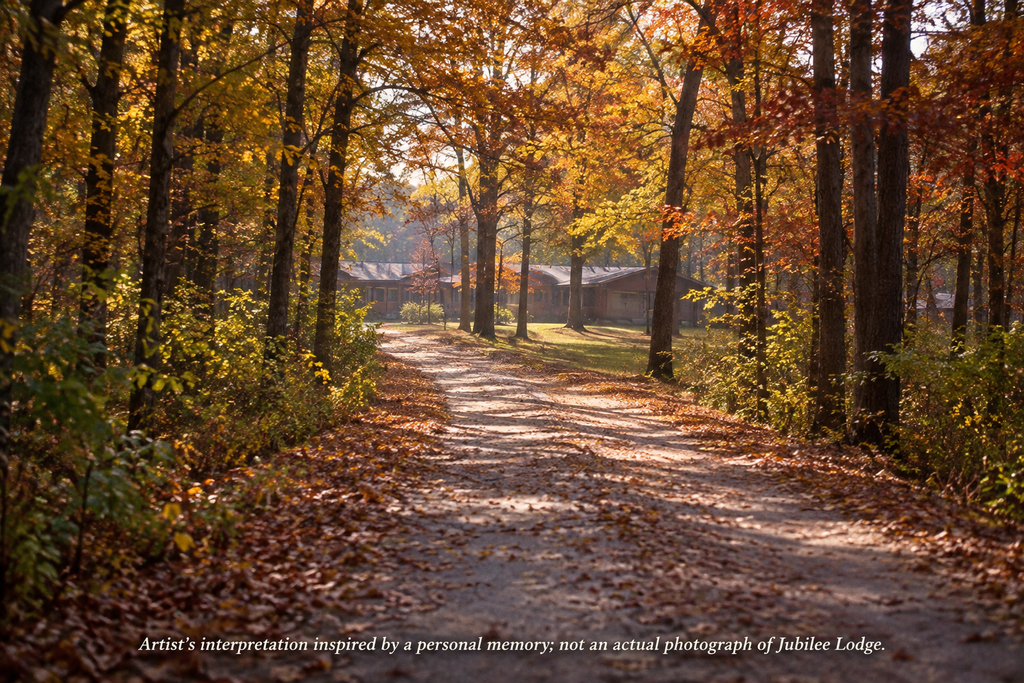
We pulled into a wooded driveway, but with the trees surrounding the property, the buildings were barely visible in the distance. It was private property, so we didn’t go any farther.
But I never forgot that place.
Years later, while talking with my sister, I learned that she remembered Jubilee Lodge, too—although for a very different reason.
She recalled our mother warning her that if she didn’t behave, she might end up there!
That made me even more curious. What was this place that my first husband knew about, that my mother remembered, and that seemed to have disappeared into the woods?
I started digging through old newspapers and historical records, looking for answers.
What I discovered was a fascinating—and surprisingly difficult to trace—piece of Peoria County history.
It Began With a Boys’ Forestry Camp
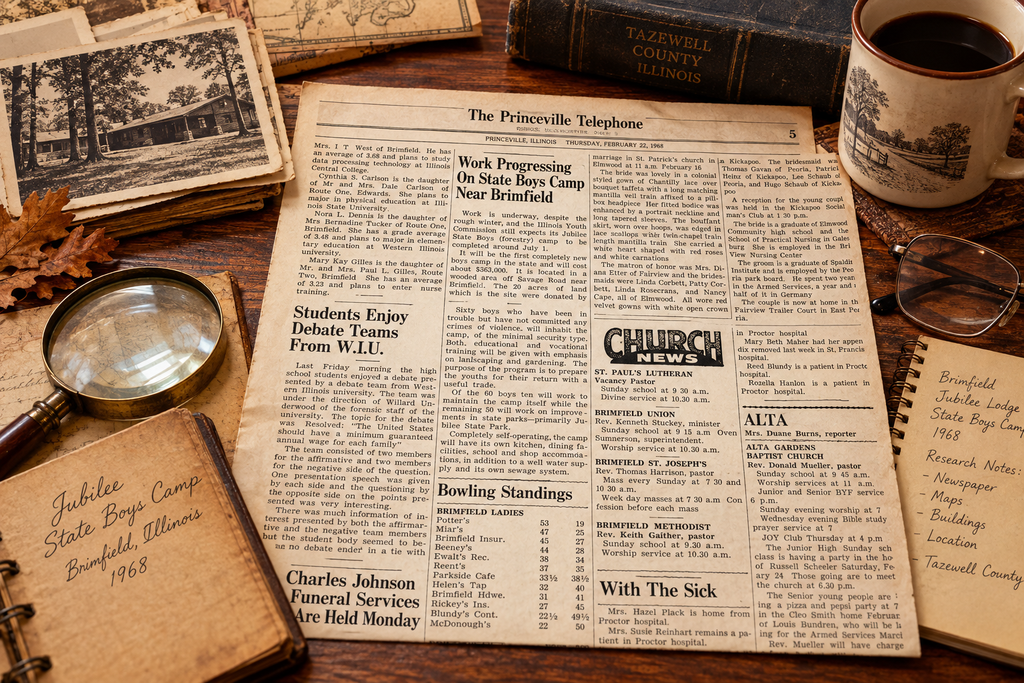
In February 1968, The Princeville Telephone reported that construction was underway on a state boys’ forestry camp near Brimfield.
The facility was being built in a wooded area off Savage Road, on 20 acres donated by the Forest Park Foundation.
The plans included living quarters, classrooms, a kitchen, dining facilities, and areas for vocational training.
The camp was intended to accommodate as many as 60 boys, providing education and opportunities to learn practical skills. Conservation and landscaping work, including activities associated with nearby Jubilee State Park, were part of the planned program.
By January 1969, construction was nearing completion.
But another chapter was already taking shape.
A New Beginning for Girls
In October 1969, The Princeville Telephone reported on the dedication of Jubilee Lodge for Girls, attended by Illinois Governor Richard B. Ogilvie.
According to the newspaper, the lodge had originally been planned as an addition to the Illinois Youth Commission’s forestry camp. A change in plans resulted in a new correctional facility for girls, described at the time as the first newly built facility of its kind in Illinois in 75 years.
The buildings were designed with large windows, exposed beams, colorful interiors, and views of the surrounding woods.
The program offered academic classes, music, art, physical education, crafts, and home-management instruction, among other activities.
These descriptions came from contemporary reporting and state officials. What daily life was actually like for the girls who lived there is another part of the story I would love to understand.
Life at Jubilee Lodge
A December 18, 1969, newspaper article announced the appointment of Michael J. Dolan as superintendent of Jubilee Lodge for Girls.
The Illinois Department of Corrections’ 1970–71 annual report offers a glimpse into its early operation.
The report recorded a rated capacity of 36 residents, an average daily population of 24 during 1970, and a total of 78 girls served that year.
At the end of 1970, the institution employed 33 full-time staff members. The average length of stay was approximately 7.4 months.
The state described Jubilee Lodge as an open, minimum-security residential treatment center, offering education, counseling, group activities, and opportunities for family involvement.
For a time, this wooded location outside Brimfield was part of the lives of young women from across Illinois.
The Boys Return
The girls’ program did not last long.
An Illinois Court of Claims decision later documented that Jubilee Lodge closed in September 1971 and reopened on June 1, 1972, as a facility for juvenile male offenders.
A small community notice in the April 12, 1973, edition of The Princeville Telephone mentioned Larry Jaeckle, who was employed at Jubilee Lodge for Boys.
It was a brief reference, but it helped confirm that the boys’ facility was operating in 1973.
Then another newspaper discovery revealed that the story was far from over.
A Work-Release Center Near Brimfield
While reading the May 6, 1976, edition of The Telephone, I came across an article about Agnes Moushon of Brimfield.
At age 50, she had earned her bachelor’s degree from Eureka College while balancing a full-time job and the responsibilities of a large family.
The article explained that she had previously supervised girls at Jubilee Lodge. That experience had helped inspire her to continue her education.
But tucked into her story was an unexpected detail.
The newspaper described Jubilee Lodge as “now a work release center near Brimfield.”
Suddenly, the history of the property had another chapter.
Then, in the October 21, 1976, edition of The Telephone, I found an article about the Peoria Work-Release Center, described as being east of Brimfield and operated by the Illinois Department of Corrections.
The article identified Michael J. Pavich as the center’s supervisor.
Was the Peoria Work-Release Center the former Jubilee Lodge operating under a different name?
The newspaper descriptions suggest a possible connection, but I have not yet found documentation establishing that they were the same facility.
It’s one of the mysteries I hope to solve.
And Then the Trail Goes Quiet
The Illinois Department of Corrections’ fiscal year 1978 annual report lists the state’s juvenile institutions, but Jubilee Lodge no longer appears among them by name.
The report also mentions a Peoria community correctional center, although it doesn’t specifically connect that operation to Jubilee Lodge.
So far, I haven’t found an official record establishing exactly when the lodge or its later operations permanently closed.
And that brings me back to those buildings I remember seeing through the trees in the 1980s.
Were they part of the original Jubilee Lodge complex? When did the last residents leave? And what eventually happened to the buildings?
Those questions remain unanswered.

The History That Almost Slipped Through the Cracks
One thing I never expected when I started investigating Jubilee Lodge was just how difficult it would be to find its history.
Here was a state-operated facility that existed within my own lifetime, yet finding a complete account of what happened there proved surprisingly challenging.
I searched government reports, historical records, newspaper archives, and old documents. Some records were difficult to access, others offered only fragments, and many questions remained unanswered.
But the real breakthroughs came from small-town newspapers.
A construction announcement in 1968. A dedication ceremony in 1969. A brief mention of an employee in 1973. And, perhaps most surprisingly, a 1976 article about a Brimfield mother earning her college degree that casually mentioned Jubilee Lodge had become a work-release center.
None of those articles told the entire story. But together, they helped piece together a history that was surprisingly difficult to trace.
And here’s something that deserves special recognition: the Brimfield Public Library District and the preservation of its historical newspaper collection.
The library’s digital archives made old editions of The Princeville Telephone and The Telephone accessible to researchers like me.
Without those preserved newspaper pages, many of the details I uncovered might have remained buried in aging paper copies, or simply been overlooked.
The reporters who originally documented these events deserve credit, too. They recorded everyday happenings that may not have seemed historically significant at the time but became invaluable decades later.
I also located a collection of Illinois Department of Corrections and Juvenile Division records held by the University of Illinois Springfield. Those archives may contain additional correspondence and reports that could help answer questions about Jubilee Lodge’s later years.
I haven’t yet examined the relevant archival folders, so the investigation is far from finished.
This experience reminded me that preserving local history takes more than one person. It takes reporters who document it, communities that save it, and people willing to make those records accessible to future generations.
Sometimes history isn’t lost because nobody recorded it.
Sometimes it’s simply waiting for somebody to look in the right place.
If exploring forgotten places and uncovering local mysteries interests you, Halloween week is the perfect time for another adventure! Check out my Spooky Tours post for more eerie destinations and fascinating stories worth exploring.
Do You Remember Jubilee Lodge?
I’m especially interested in hearing from anyone who remembers Jubilee Lodge for Girls, Jubilee School for Boys, or the Peoria Work-Release Center near Brimfield.
Did you work there? Did someone in your family work there? Do you remember visiting the property, seeing the buildings, or hearing stories about the facility?
I’d love to learn more about its later years, when it closed, and what became of the buildings.
If you have memories, photographs, or documents you’d be willing to share, please contact me at contactus@kellysroadsidegossip.com.
Sometimes the best pieces of local history aren’t found in official records.
Sometimes they’re found in the memories of the people who were there.
Until our next roadside discovery, keep your eyes open. You never know what stories are waiting just beyond that old country driveway.

Historical Sources and Acknowledgments
- The Princeville Telephone, February 22, 1968, p. 5 — boys’ forestry camp construction.
- The Princeville Telephone, January 16, 1969, p. 4 — construction progress.
- The Princeville Telephone, October 9, 1969 — dedication of Jubilee Lodge for Girls.
- The Princeville Telephone, December 18, 1969, p. 7 — superintendent appointment.
- Illinois Department of Corrections, Annual Report 1970–1971 — Jubilee Lodge programs and institutional statistics.
- Illinois Court of Claims, Mae Ella Buckley v. State of Illinois, No. 77-CC-0561, November 7, 1979 — 1971 closure and 1972 reopening.
- The Princeville Telephone, April 12, 1973 — reference to a Jubilee Lodge for Boys employee.
- The Telephone, May 6, 1976, p. 5 — Agnes Moushon and Jubilee Lodge’s work-release use.
- The Telephone, October 21, 1976 — Peoria Work-Release Center.
- Illinois Department of Corrections, Annual Report, Fiscal Year 1978 — juvenile institution and community correctional center listings.
Special acknowledgment: My thanks to the Brimfield Public Library District for making historical newspapers accessible through its Digital Newspaper Archives. This collection was invaluable to my research.
Additional archival leads were identified through the University of Illinois Springfield Archives.

Pingback: How Did Five Small Illinois Towns Get Their Names?