
The stories, pioneers, railroads, and mysteries behind Laura, Williamsfield, Monica, Brimfield, and Princeville.
Have you ever driven through a small town and wondered how it got its name?
Living in rural Illinois, we’re surrounded by little communities that many people pass through without giving their names a second thought. Some were named for the people who settled them. Others borrowed names from places hundreds of miles away. And some have stories that leave us with more questions than answers. While researching the history of grain elevators around Laura, Illinois, I found myself wondering about the names of five neighboring farming communities: Princeville, Brimfield, Monica, Williamsfield, and Laura.
What started as a little curiosity turned into a trip through nineteenth-century newspapers, county histories, railroad stories, and a mystery involving a young Chicago woman. And wouldn’t you know it? One of those mysteries is practically in my own backyard!
Princeville: A Pioneer Named Daniel Prince
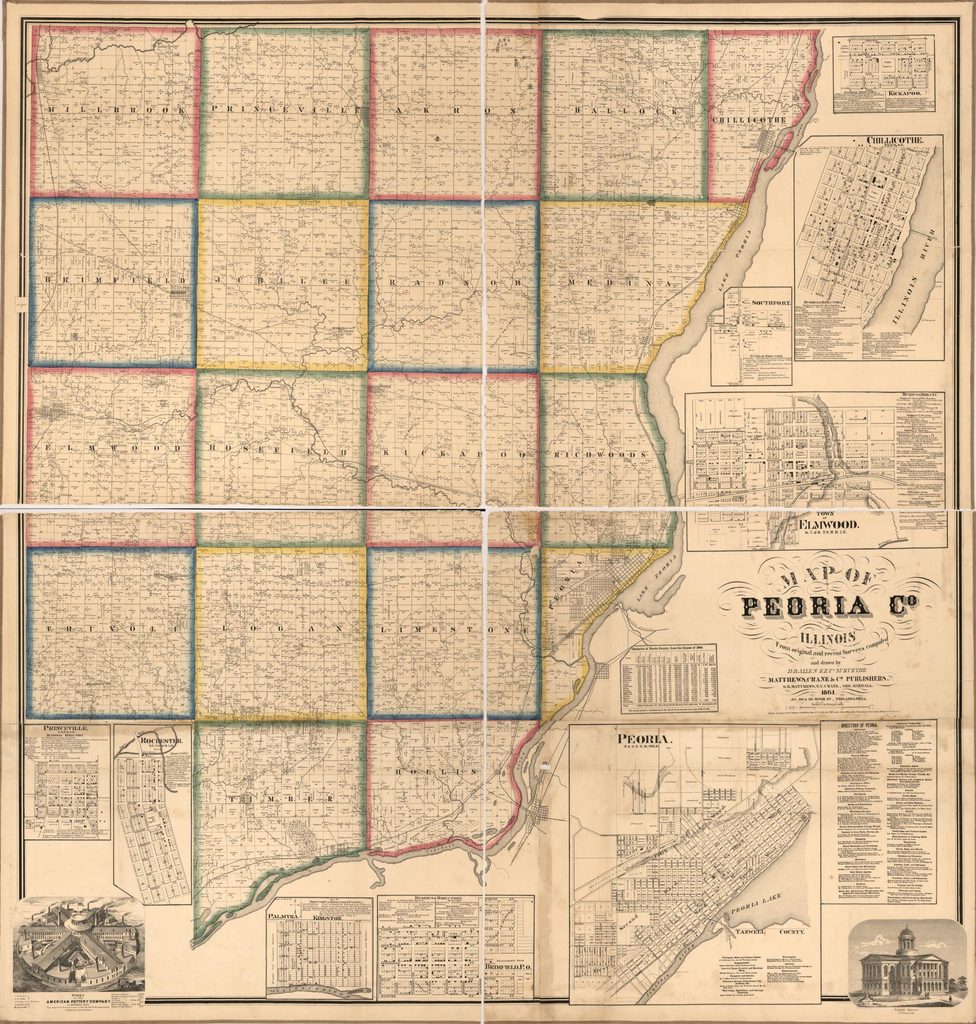
Our first stop takes us back to 1822, when a Vermont native named Daniel Prince settled in what would become Princeville Township. According to the 1880 History of Peoria County, Prince built a small log cabin measuring just 14 feet by 14 feet. Imagine starting a new life on the Illinois frontier in a home that size! The surrounding area became known as Prince’s Grove, and eventually the community took the name Princeville.
Prince wasn’t simply a name on a map. Later recollections from the Old Settlers’ Union described him as a generous neighbor who helped others during the community’s earliest years. One story describes his family opening their cabin for religious services. During one meeting, Prince reportedly returned from tending livestock, warmed himself by the fire, and climbed into bed while the preacher continued his sermon! Now that’s a fellow who knew how to make himself comfortable.
More than two centuries after his arrival, Daniel Prince’s name remains part of the community.
Brimfield: From Charleston to a Massachusetts Namesake
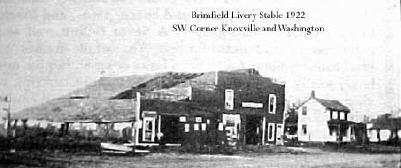
Our next stop is Brimfield, although that wasn’t its original name. Early settlers called the community Charleston. Unfortunately, Illinois already had other communities using that name, and the duplication eventually became a problem.
Enter William W. Thompson.
Thompson had moved to Peoria County from Massachusetts in 1839. He later served in the Illinois legislature and helped arrange for Charleston’s name to be changed during the 1842–1843 legislative session. The new name was Brimfield, honoring Thompson’s birthplace of Brimfield, Massachusetts.
Not everyone agreed with the choice.
An early county history reports that some residents preferred Wolcottsville, while others favored Guyersburg. Can you imagine telling someone today that you’re heading over to Guyersburg for groceries? Instead, Brimfield became the official name in 1843, and it has remained that way ever since. Sometimes a town’s name comes down to the influence of one determined individual!
Brimfield has more than its share of interesting history. In another investigation, I uncovered the story of Jubilee Lodge, a nearly forgotten facility hidden in the woods outside town. You can read about that discovery in my article, The Forgotten Buildings in the Woods: Uncovering the History of Jubilee Lodge.
Monica: A Greek Princess in Illinois Corn Country?
Now here’s a naming story I certainly didn’t expect. Monica was laid out on June 26, 1873, by Solomon S. Cornwell. And originally, the village was called Cornwell. That seems straightforward enough. A man establishes a community, and the community takes his name. But somewhere along the way, the name changed.
According to the 1880 History of Peoria County, William J. Phelps gave the village the name Monica, reportedly after a Grecian princess. Yes, you read that correctly. A Greek princess! Right here in the middle of Illinois farming country.
The old history doesn’t explain which princess Phelps had in mind or why her name appealed to him. Was there a particular story he admired? Had he read about her somewhere? Or was there another reason behind the choice? For now, that part remains unanswered. But I have to admit, Monica’s naming story adds a little unexpected royalty to our collection of prairie towns.
Williamsfield: A Railroad Official and a Field of Corn
By the late nineteenth century, railroads were changing the landscape of rural Illinois. New railroad lines meant new shipping opportunities for farmers. Communities developed around depots, grain elevators, stores, and other businesses serving the surrounding countryside. Williamsfield was laid out in 1888, during this period of railroad expansion.
According to the Williamsfield Centennial History, a railroad official named Williams supposedly looked across the surrounding cornfields and suggested the name Williams Field. It’s a wonderful image, isn’t it? A railroad official looking out over the Illinois prairie, seeing cornfields stretching toward the horizon, and finding the perfect name for a new community. But who exactly was Mr. Williams?
That’s where my research gets interesting. An 1898 newspaper account connects Williamsfield to Norman Williams, a prominent Chicago attorney associated in that report with the Santa Fe Railroad. The story suggests the town was named for him.
However, I haven’t yet located the original naming record or independent railroad documentation that would establish exactly how the decision was made. So I have two historical accounts pointing toward a railroad connection, but a few missing pieces remain. And those missing pieces lead me directly to our final town.
Laura: Who Was the Woman Behind the Name?
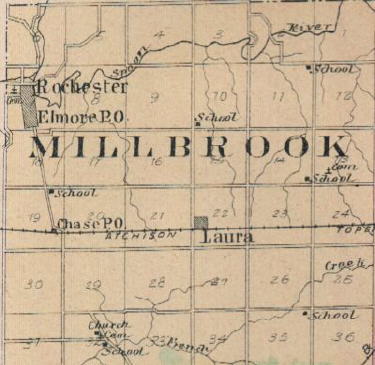
Of all five communities, Laura has become my favorite historical mystery. Maybe that’s because it’s so close to home. According to an early Millbrook Township history, the Santa Fe Railroad reached the area in 1887, and James M. Kellar laid out the village of Laura in 1888.
But why Laura? For years, the name may have seemed like just another familiar place on the map. Then I came across a fascinating newspaper article.
On October 27, 1898, The Brimfield News published an account credited to the Peoria Journal concerning the marriage of Major General Wesley Merritt and Miss Laura Williams of Chicago.
The article described Laura’s father as an attorney connected with the Santa Fe Railroad during its construction. And then came the detail that caught my attention. The account reported that Williamsfield was named for her father and the neighboring village of Laura for his daughter. Suddenly, two little Illinois towns had a possible connection to one Chicago family.
Following the Trail of Laura Williams
Naturally, I wanted to know more.
Another newspaper, the Galena Weekly Gazette of May 26, 1898, identified the young woman as Laura Williams, daughter of Norman Williams, a Chicago attorney. That helped establish that Laura Williams was a real person and that her father was Norman Williams. But did the railroad actually name the village in her honor?
Here’s the catch.
The 1898 naming account included the qualification “so the story goes.” Those four little words matter. They tell us that the newspaper was passing along a story, not necessarily documenting the original decision. I still haven’t found the railroad correspondence, original town records, or another firsthand account that proves the naming explanation. And while the story is certainly plausible, history deserves more than a good guess.
So for now, Laura Williams remains a possible namesake rather than a confirmed one.
Would you like to see what Laura Williams looked like?
During my research, I found a photograph identified as Laura Caton Williams Merritt Wilder on FamilySearch. Click here to see Laura’s photograph and explore her family history.
Five Towns, Five Stories, and a Little Mystery
What I find most interesting about these communities is how differently their names came about.
Princeville remembers an early pioneer.
Brimfield carries a name brought from Massachusetts.
Monica has an intriguing story about a Greek princess.
Williamsfield may owe its name to a railroad official looking across the cornfields.
And Laura may have been named for a young woman whose father had connections to the railroad that helped bring the village into existence. Different names, different histories, but all connected to the development of rural Illinois.
As the farms grew and railroads expanded, grain elevators became familiar landmarks in these communities. Those elevators and the people who worked around them will be the subject of another story. For now, though, I’m still thinking about Laura.
More than a century after that 1898 newspaper article appeared, the village continues to carry a name that may have belonged to a young woman from Chicago. Was Laura, Illinois, really named for Laura Williams Merritt? Or was it a story that grew alongside the railroad towns themselves? Somewhere in an old family letter, a railroad document, a forgotten newspaper, or a dusty county record, the answer might still be waiting.
And you can bet I’ll keep looking.
Do you know a story about how one of these communities got its name?
Maybe your family has an old photograph, newspaper clipping, or story passed down through generations. I’d love to hear it. After all, sometimes the best pieces of local history aren’t found in books. They’re remembered by the people who call these little towns home.
Until next time, keep your eyes open. You never know what a little roadside gossip might uncover!
Kelly Jo
Kelly’s Roadside Gossip
Historical Sources & References
1. Peoria County Township Histories Read the township histories
Background on early settlements, including Princeville and Millbrook Township.
2. The Brimfield News Historical Archives Explore the newspaper archives
Includes our October 27, 1898 newspaper account connecting Laura Williams and Norman Williams to the names of Laura and Williamsfield.
3. Williamsfield Centennial History Read the Williamsfield Centennial History (PDF)
Our source for the railroad official and cornfield naming tradition.
4. Illinois Digital Newspaper Collections Search Illinois historical newspapers
5. Galena Weekly Gazette — May 26, 1898
Article: “Gen. Merritt’s Fiancee”
This historical newspaper article identifies Laura Williams as the daughter of Chicago attorney Norman Williams and discusses her engagement to Major General Wesley Merritt.
Source: Galena Weekly Gazette, Vol. 127, No. 27, May 26, 1898.
🐾 Buck’s Bark Replay
Missed a link along the way? Buck’s got you covered!
Here are a few places and resources mentioned in today’s adventure.
- Forgotten History: Jubilee Lodge in Brimfield — Another fascinating piece of small-town Illinois history.
- FamilySearch — Explore historical records, family connections, and the people behind small-town history. https://www.familysearch.org/
- Find a Grave — Discover cemetery records and memorials that help piece together local history. https://www.findagrave.com/
