I always had a plan for retirement. I was going to travel and give back to my community. I wanted a camper van, and I wanted to travel with my partner and see all those amazing places we had dreamed about. I wasn’t exactly sure what “giving back” was going to look like.
While I was living in Pekin, I couldn’t help but notice how many people were living on the streets. At first, I thought I would volunteer at a homeless shelter, so I started researching organizations in the area. As I researched, I began noticing a pattern. There were organizations doing important work to meet people’s immediate needs. Some provided food and temporary shelter. Others stepped in where those services ended, providing tents, hygiene essentials or a place to shower. Those things matter. When someone is in crisis, they need food. They need somewhere safe to sleep. They need clean clothes, hygiene products and the basic necessities of life. But I kept wondering:
What happens next?
What I wasn’t seeing was something that addressed the bigger question of how a person moves beyond simply surviving the crisis.
An Idea Begins to Grow
At first, I considered opening transitional housing where people’s immediate needs could be met while they also learned the skills they needed to move beyond survival mode. My boyfriend at the time wasn’t exactly thrilled with this idea. His concern was that I would be working with people struggling with addiction, alcoholism and other serious problems. He told me, “You can’t help people who don’t want to be helped.”
My response was pretty simple.
I only have to help one person to be a success, right?
And, of course, that got me overthinking—because that’s what Kelly does. How was I going to fulfill my dream of traveling, give back to my community and still address some of my partner’s concerns? I finally decided I would do what I knew how to do. I would create my own program.
When My Own Plans Changed
Then life changed the plan again.
My partner removed himself from that dream and moved on to someone else. Suddenly, I was facing my own version of starting over. My circumstances were very different from those of the people I wanted to help, but the experience reinforced something I already believed.
People should not be defined or judged solely by the circumstances they find themselves in.
A crisis is a place in someone’s life. It doesn’t have to become their identity. People can lose relationships. Homes. Jobs. Financial security. Sobriety. Confidence. Support systems. Sometimes several things disappear at once. And when you’re trying to survive today, imagining a completely different tomorrow can feel impossible. That realization helped shape what I wanted Beyond Survival to become.
From Crisis to Stability
I started creating a program built around a simple progression:
From Crisis to Stability. From Stability to Purpose.
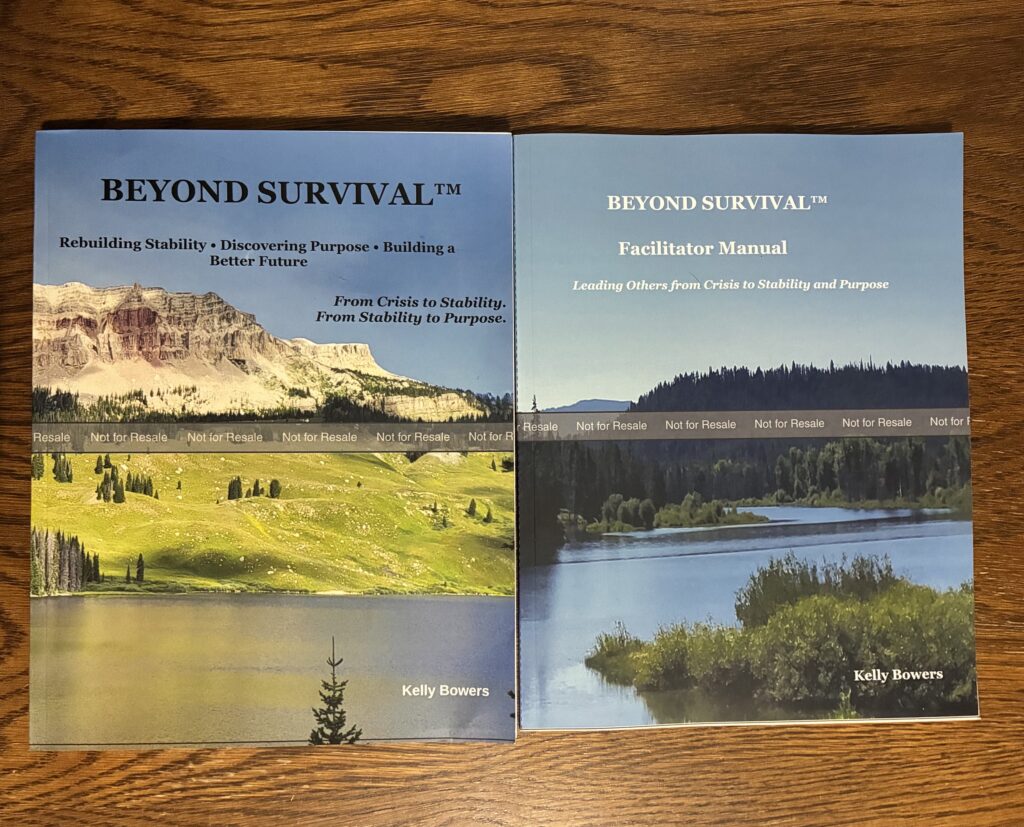
seeing the books in print for the first time made the whole project feel real.
That became Beyond Survival™.
It started as a Participant Workbook, but I quickly realized something. I understood how I intended the material to be taught because I created it. Someone running a shelter, church, rescue mission or community program wouldn’t have that same information living inside their head. If I wanted Beyond Survival to reach people I might never meet, I needed to create something another person could pick up and actually teach.
So one workbook became a series.
I created the Beyond Survival™ Participant Workbook for the person going through the program and a Facilitator & Teacher Manual for the person leading it.
What Beyond Survival Actually Does
Beyond Survival is designed as a 12-week program that can be used by shelters, rescue missions, churches, recovery and reentry programs, nonprofits and other community organizations. The purpose isn’t to replace the services people desperately need during a crisis. It’s designed to help answer what comes next. Each week gives participants an opportunity to learn, reflect, participate in activities, discuss what they’re experiencing and take another step toward stability and purpose. The program is designed for small groups, with sessions lasting about 60 to 90 minutes. The Facilitator & Teacher Manual provides the structure for leading those sessions so an organization doesn’t have to invent a program from scratch.
There are opportunities for discussion, activities and weekly challenges, along with follow-up points after the 12-week program because rebuilding a life doesn’t magically end when a class does.
The goal isn’t perfection.
It’s progress.
One decision. One skill. One goal. One step at a time.
More Than a Book
When I started this, I wasn’t setting out to become a publisher. I certainly wasn’t sitting there thinking, You know what retirement needs? Deadlines, formatting problems and learning how to publish books. 😂 But somewhere along the way, that’s what happened.
Beyond Survival pushed me outside my comfort zone. I had to take an idea that made sense inside my own head and turn it into something another person could hold, understand and use.
And when the finished books finally became real, I realized I had accomplished something bigger than writing a workbook. I had created a way for my desire to help people to travel farther than I could. I can volunteer at one shelter and help the people who happen to be there while I’m there. But a program can go somewhere I can’t.
A facilitator I’ve never met can pick it up. A church in another town can use it. A participant I may never know can work through it. Maybe most people who encounter Beyond Survival will never know who Kelly Bowers is. That’s okay. Because I still believe what I believed when this whole idea began:
If it helps one person move forward, it was worth creating.
Purpose Doesn’t Always Look Like the Plan
I still want that camper van. I still intend to travel. I still want to see those places I’ve dreamed about and discover a whole bunch of places I don’t even know exist yet. But I’m beginning to understand that retirement wasn’t really about finally reaching the life I had planned. It was about having the freedom to discover what I could do with the life in front of me.
Beyond Survival became one piece of that.
The funny thing is that I created a program about moving from crisis to stability and from stability to purpose while I was also learning how to navigate an unexpected change in my own life.
Maybe purpose isn’t something you suddenly find waiting for you at the end of the road.
Sometimes you build it while you’re traveling.
From Crisis to Stability.
From Stability to Purpose.